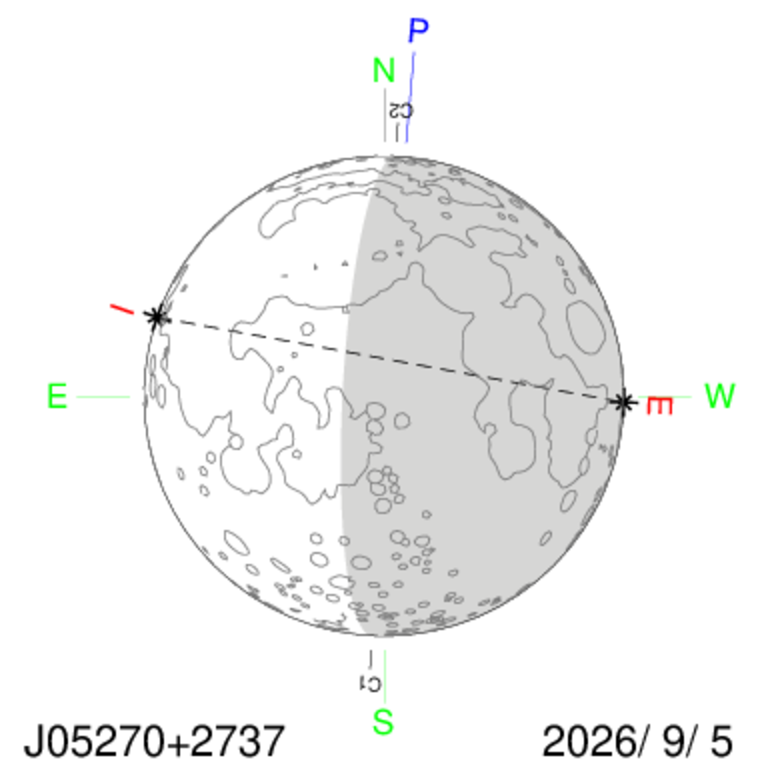
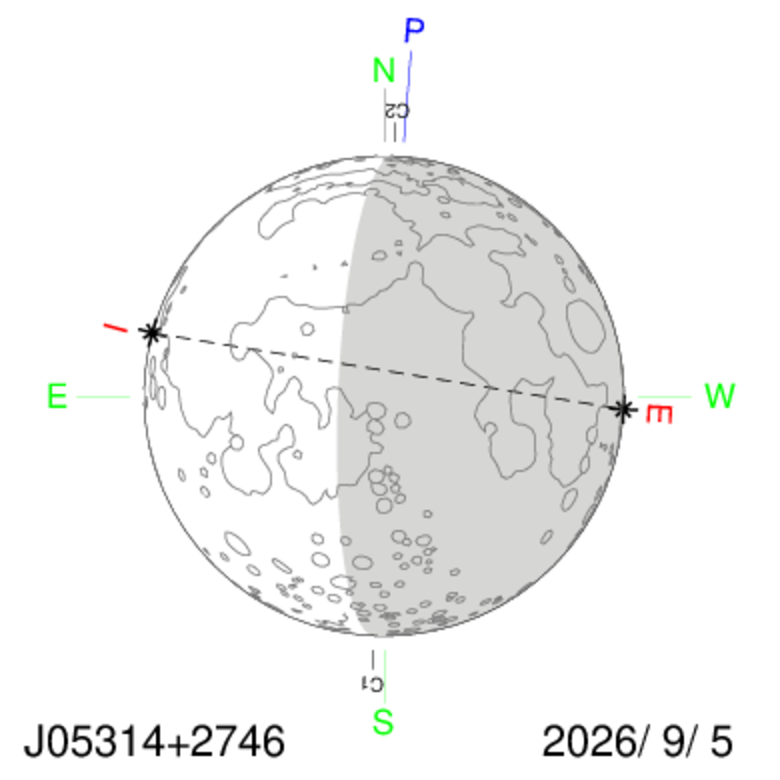
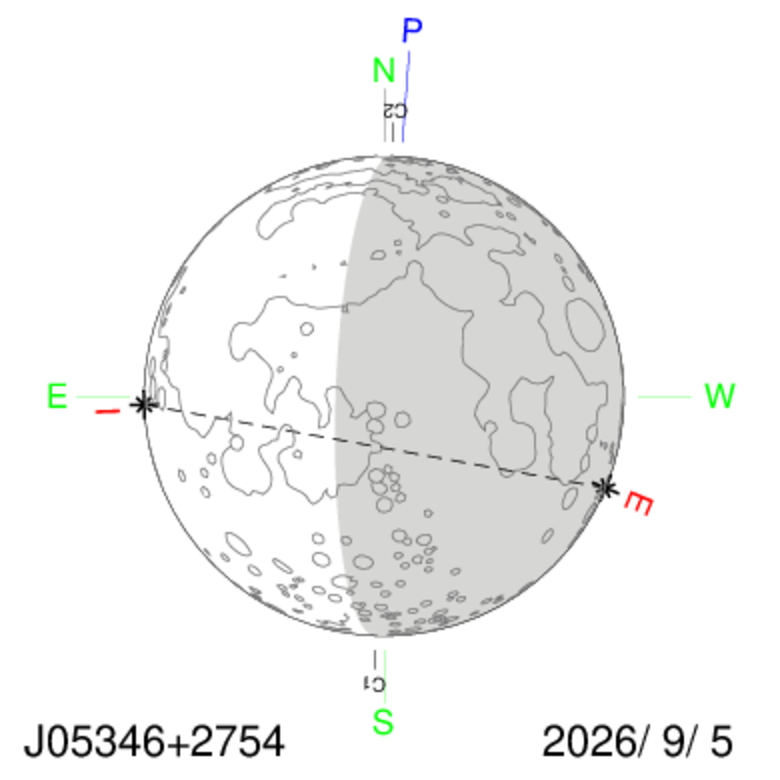
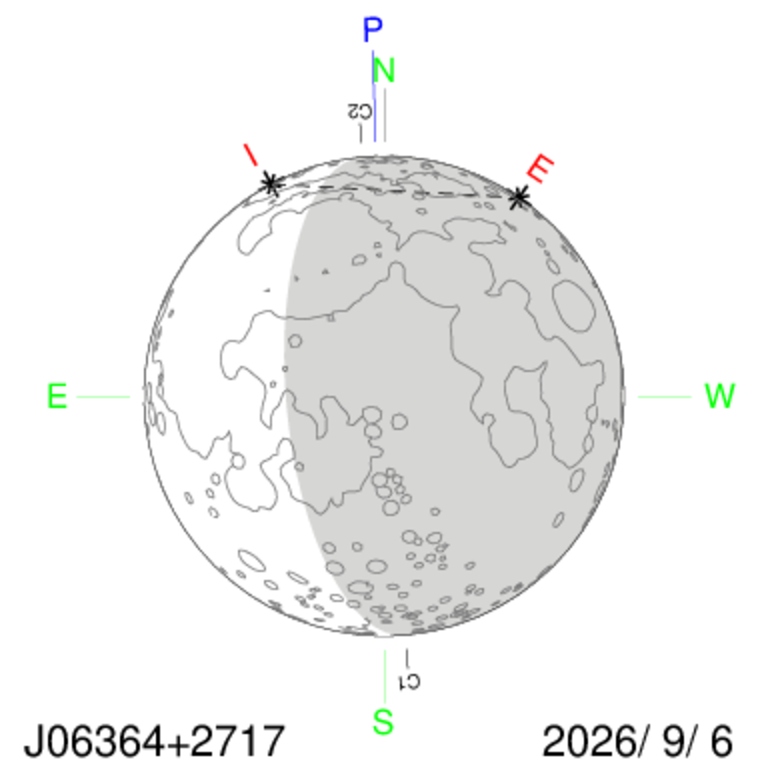
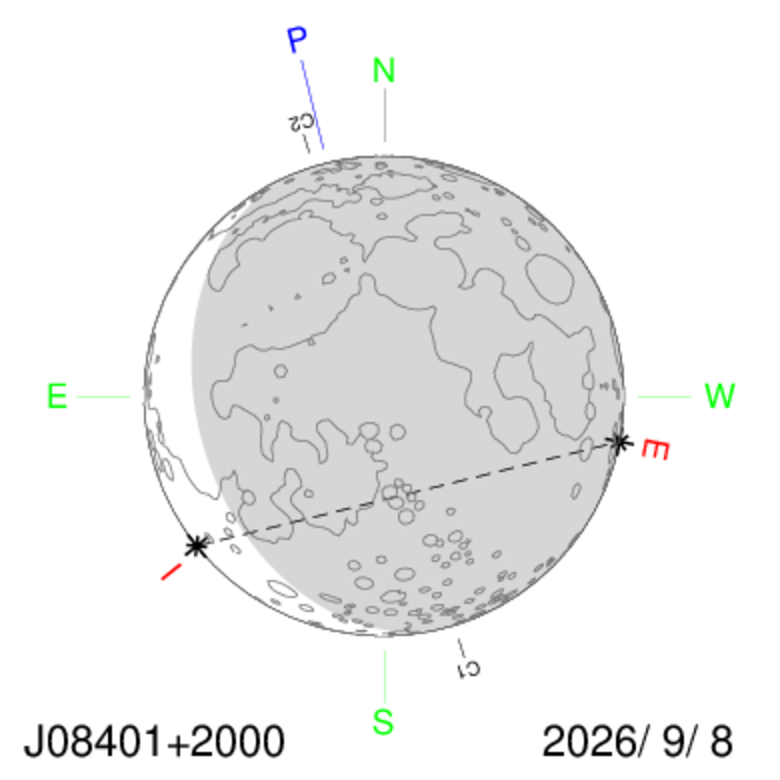
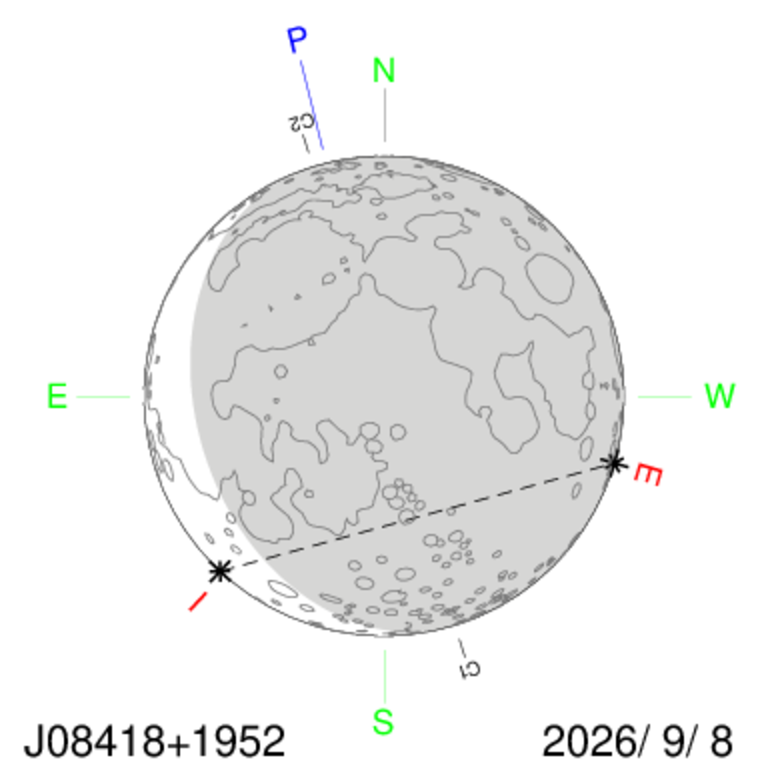
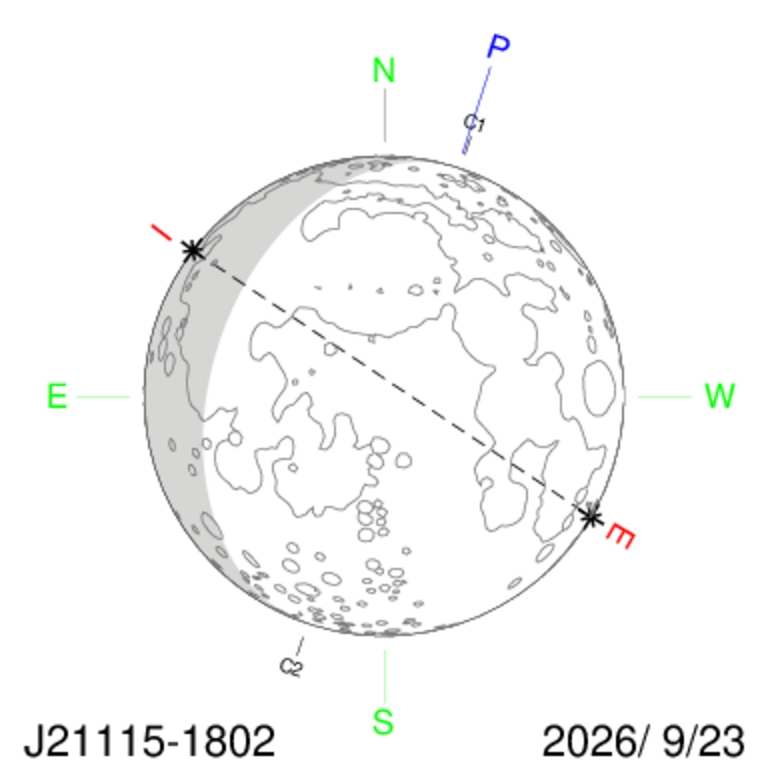
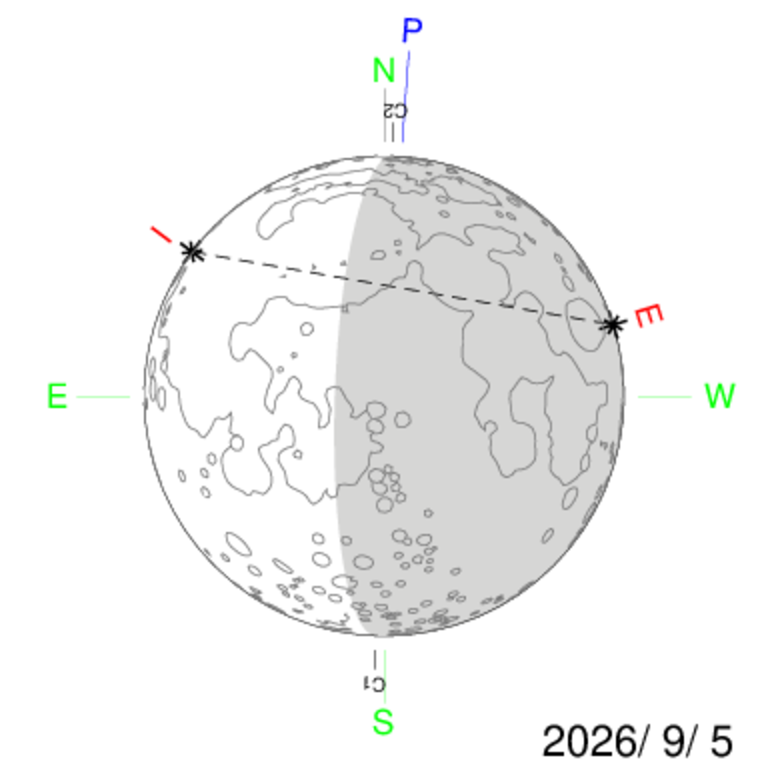
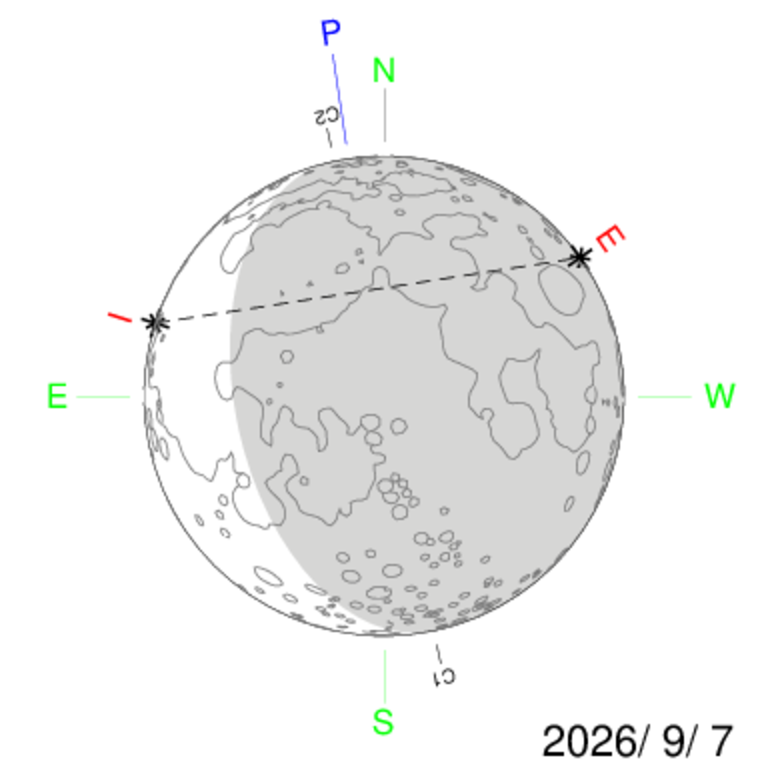
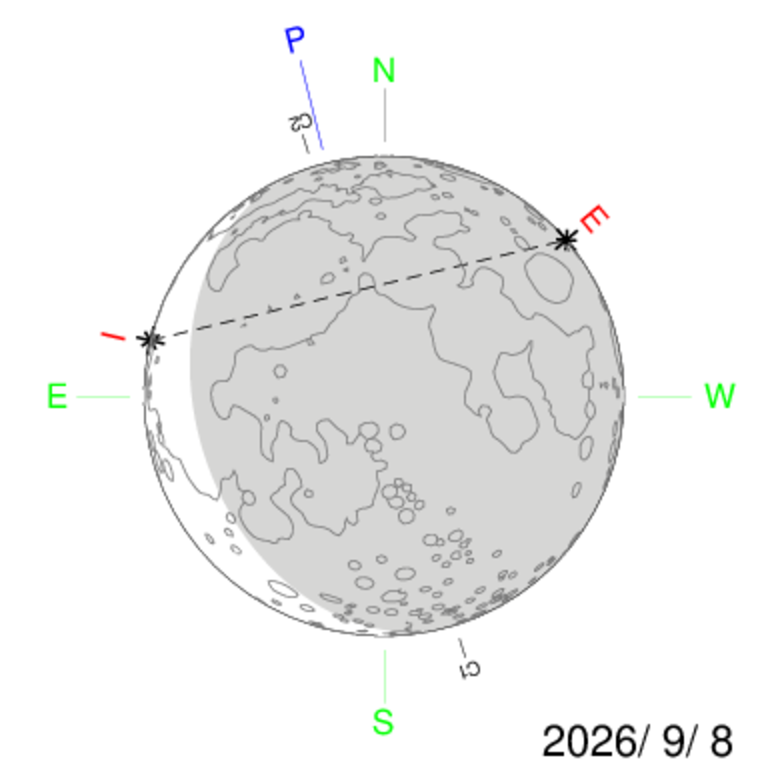
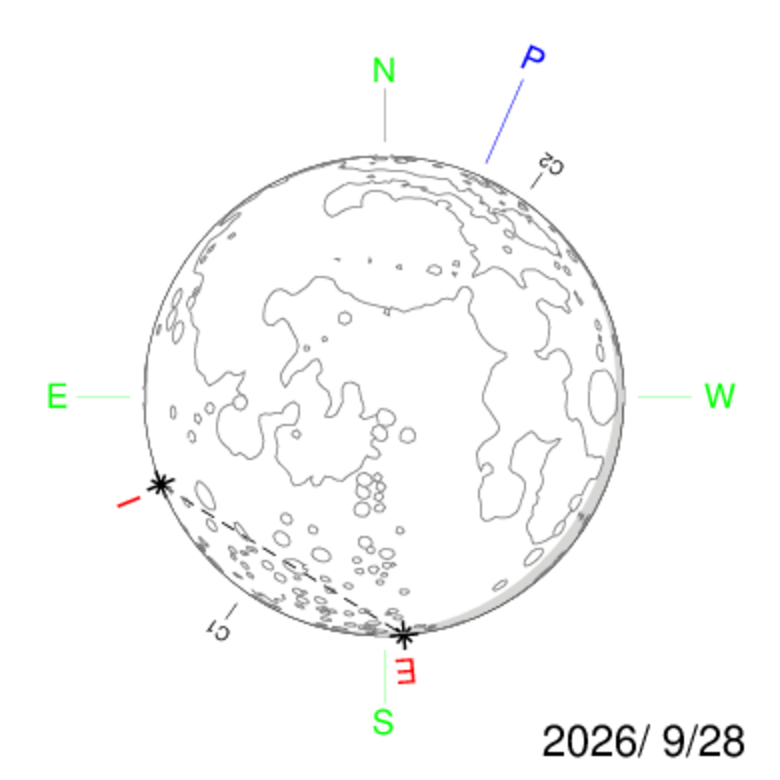
The table below
(check here for key)
Urg: Degree of urgency of the observation. A: High. B: Low.
Day: Day of occultation.
UTC: UTC of occultation in Madrid (in black), Barcelona
(green),
La Laguna (red),
Marseille (blue), and Berlin (orange).
Note that some events might be visible in some places and not in others (check column "OLED").
Star (WDS): ID number of star in WDS (Washington Double Star) catalogue.
RA: J2000.0 right ascension (hh mm ss.ss).
DEC: J2000.0 declination (dd mm ss.s).
Mags: Magnitude of components and total magnitude.
Year: Year of last observation.
# obs: Total number of observations.
Sep: Last measurement of separation between components, in arcseconds.
PA: Last measurement of position angle, in degrees.
Type: Type of occultation. I: ingress. E: egress.
Flux: Fractional change of flux in reference to combined flux.
The two values refer to ingress or egress of each component.
Illum: % fraction of illuminated area of Moon (positive, waxing Moon; negative, waning Moon).
Def: Distance from contact to Moon terminator, in arcseconds.
γ: Position angle of contact in ° (from N to E).
hSun: Height of Sun above horizon in reference location at contact time, in °.
hMoon: Height of Moon above horizon in reference location at contact time, in °.
Graph: Schematic of the chord as seen from the location specified in column "UTC".
OLED: Circumstances for OLED observers with a user acronym and for different European and Northern African cities.
shows the occultations of the WDS programmme for SEPTEMBER 26.
Please report observations by writing an email to
enrique.velasco@uam.es.
For more accurate predictions on these occultations for your position, visit
this link
and choose "WDS (double stars)" as the "Object catalogue". To quickly check for
visibility of an occultation from your particular station, click on
column "OLED", and look for your acronym.
The following table
(check here for key)
Day: Day of occultation.
UTC: UTC of occultation (see location by placing the mouse on the time).
Note that some events might be visible in some places and not in others (check column "OLED").
Gaia DR3: ID number of star in Gaia DR3 catalogue (check SIMBAD CDS database by placing the mouse on the number).
Table: Type of star in the Gaia DR3 NSS catalogue (accel: accelerated star; 2-body: star with a calculated orbit).
RA: Right ascension of star in ICRS (hours, minutes and seconds).
DEC: Declination of star in ICRS (hours, minutes and seconds).
Mag: Magnitude of star.
Type: Type of occultation. I: ingress. E: egress.
Illum: percentage of Moon illuminated. Positive: waxing Moon. Negative: waning Moon.
Def: defect of illumination at contact (radial distance from contact to terminator), in seconds of arc. Calculated in events at dark limb.
γ: position angle of event in degrees, measured from north celestial pole in the positive sense (eastward).
hSun: Height of Sun above horizon in reference location at contact time, in °.
hMoon: Height of Moon above horizon in reference location at contact time, in °.
Graph: Schematic of the chord as seen from the location specified in column "UTC".
OLED: Circumstances for OLED observers with a user acronym and for different European and Northern African cities .
lists the suggested targets from the Gaia DR3 NSS catalogue.
UTC and all other data are given for a specific reference location (hover over the UTC time to see where).
Please note that the event may not be visible from your location. To check for visibility, and for
more detailed predictions, please visit this link
and choose "GAIA nonsingle stars" (in future months an "OLED" column showing contact times for all observers and stations will be available).